
Campsites, tailgates, jobsites, food trucks — and the storm that takes your block out. Cummins Onan portables go where the work and the fun go, with inverter power clean enough for a laptop and dual- and tri-fuel models that switch fuels at the turn of a dial.
As quiet as 52 dB(A)Gasoline · Propane · Natural gas3-year residential warranty
A standby generator waits on a pad for the one bad night. A portable comes with you — and earns its keep every weekend in between. Cummins Onan builds them the way it builds the units backing hospitals and data centers: four-stroke OHV engines, real displays, and clean enough power for the electronics you’d never plug into a cheap generator.

Double insulation on the inverter models means exceptionally quiet operation, and proven four-stroke overhead-valve engines deliver durable, dependable performance year after year.

From the 48-lb, carry-it-one-handed P2500i to the highly maneuverable P9500DF on 10-inch wheels, every model is built to be moved by the person who owns it.

10 to 18 hours of continuous operation at 25% load on a single tank of gasoline — and a standard 20-pound propane tank delivers roughly eight more hours on the dual-fuel models.

Push-button start and a wireless key fob — up to 109 yards on the P9500DF — with a pull cord still there as backup. Startup is as simple as pressing a button from the porch.

Power output, fuel level, voltage, remaining run time and lifetime hours — the digital display gives you the critical facts at a glance instead of a guess.

The P2500i and P4500i inverter models pair with a comparable unit through a Cummins paralleling kit — a second small generator instead of one big one when the load grows.

Low total harmonic distortion — 3% or less on the inverter models — provides the clean power laptops, phones, card readers and modern TVs need without the risk.

AC and DC together, including USB ports — plus RV-ready 30A and 50A outlets on the bigger units. Every outlet is covered to keep dust and grit out between jobs.

Circuit breakers are mounted right on the panel for a rapid reset — and CO detection with automatic shutoff comes standard on the EFI and tri-fuel models.
Gasoline · Every model
Every Onan portable runs gasoline out of the box — 1 to 6.6 gallons depending on the model, good for 10 to 18 hours of continuous running at a 25% load factor.
Propane · DF & TF models
Flip the fuel selector and a standard 20-lb grill tank takes over — up to 22 hours at 25% load on the P4500iDF. Propane doesn’t go stale in the shed over the winter.
Natural gas · P11000iTF
The tri-fuel P11000iTF adds a natural gas connection, so at home it runs off the same line as your grill or dryer — no refueling trips in the middle of an outage.
The P2500i and P4500i inverter models parallel with a comparable unit through a Cummins paralleling kit — 30-amp for the P2500i, 50-amp for the P4500 family. It’s the practical answer when you already own one and the load grew: buy a second, carry them separately, run them together.
Sound levels, run times and outlets are what actually separate these units — not just watts. Open any spec panel below for the full picture, or tell us what you need to run and we’ll point you at the right one.
01 — Inverter · Gasoline
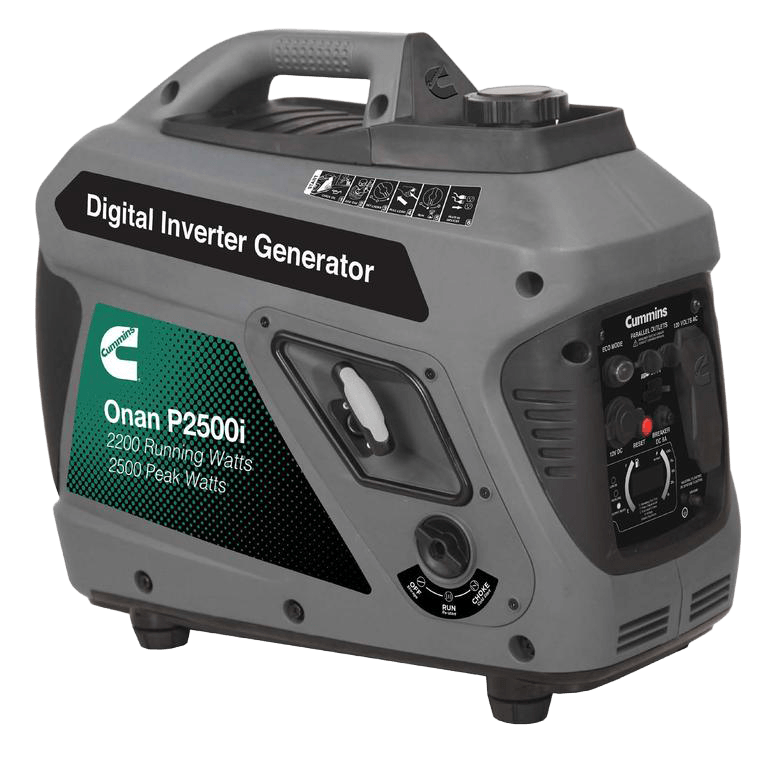
Inverter2,500 W peak
The one you carry with one hand. 48 pounds, 52 dB(A), and clean enough power for phones, laptops and a TV at the tailgate — with a 12V DC outlet and two USB ports built in.
2,200 running W48 lb52 dB(A)10 hr @ 25%
| Output — gasoline | 2,500 peak W / 2,200 running W |
|---|---|
| Amps @ 120V | 20.8 peak / 18.3 running |
| Engine | 3.4 hp, 98 cc OHV four-stroke |
| Fuel tank & run time | 1 gal — 10 hr at 25% load, 8 hr at 50% load |
| Harmonic distortion | ≤3% THD |
| Outlets | One duplex 120V 20A AC (5-20R) · one 12V 8A DC car-style · two 5V USB |
| Paralleling | Ports for the Cummins 30-amp paralleling kit |
| Starting | Push button and wireless key fob, pull-cord backup |
| Display | LED graphical display · economy mode switch |
| Dimensions | 19.75 × 10.5 × 18.25 in · molded carry handle |
| Dry weight | 48 lb (21 kg) |
| Sound level | 52 dB(A) |
| Warranty | 3-year residential / 1-year commercial |
120V, single phase · Certified compliant EPA / CARB / Canadian CSA · rubber outlet dust covers · run times measured at a 25% load factor.
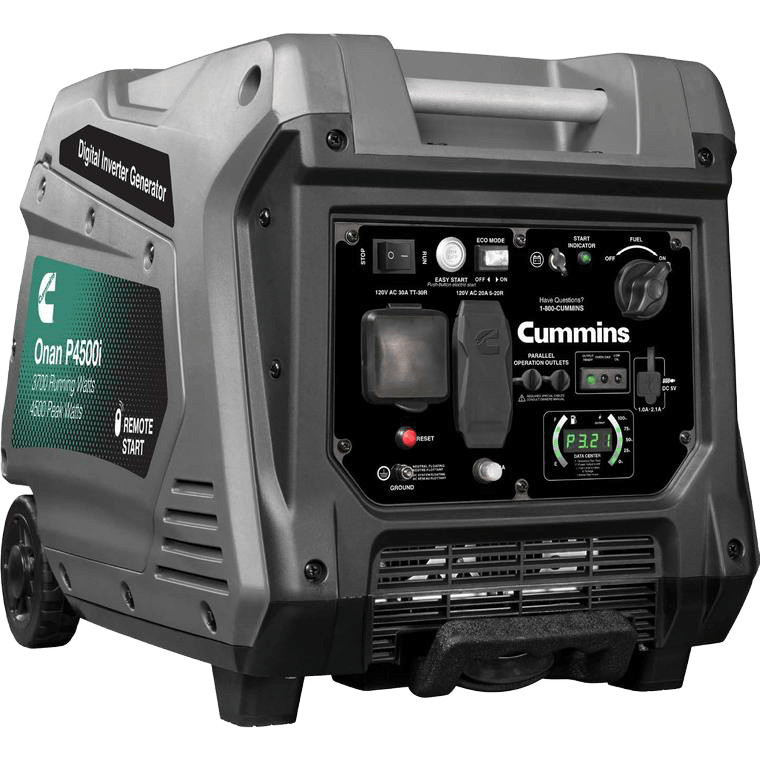
Inverter4,500 W peak
The all-rounder. RV- and camper-ready with a 30A TT-30R outlet, an 18-hour tank, and a telescoping handle on wheels so it rolls out of the garage instead of getting carried.
3,700 running W98 lb52 dB(A)18 hr @ 25%
| Output — gasoline | 4,500 peak W / 3,700 running W |
|---|---|
| Amps @ 120V | 37.5 peak / 30.8 running |
| Engine | 7.3 hp, 224 cc OHV four-stroke |
| Fuel tank & run time | 3.4 gal — 18 hr at 25% load, 15 hr at 50% load |
| Harmonic distortion | ≤3% THD |
| Outlets | One 120V 30A (TT-30R) · one duplex 120V 20A AC (5-20R) · two 5V USB |
| Paralleling | Ports for the Cummins 50-amp paralleling kit |
| Starting | Push button and wireless key fob, pull-cord backup · battery charger |
| Display | LED graphical display — run time remaining, power, fuel level, voltage, total hours |
| Dimensions | 24.5 × 18.25 × 20.5 in · telescoping handle, 5.5 in wheels |
| Dry weight | 98 lb (44 kg) |
| Sound level | 52 dB(A) |
| Warranty | 3-year residential / 1-year commercial |
120V, single phase · Certified compliant EPA / CARB / Canadian CSA · economy mode switch · parallel capable with another inverter generator to reach 50A.
02 — Dual-Fuel Inverter · Gas or Propane
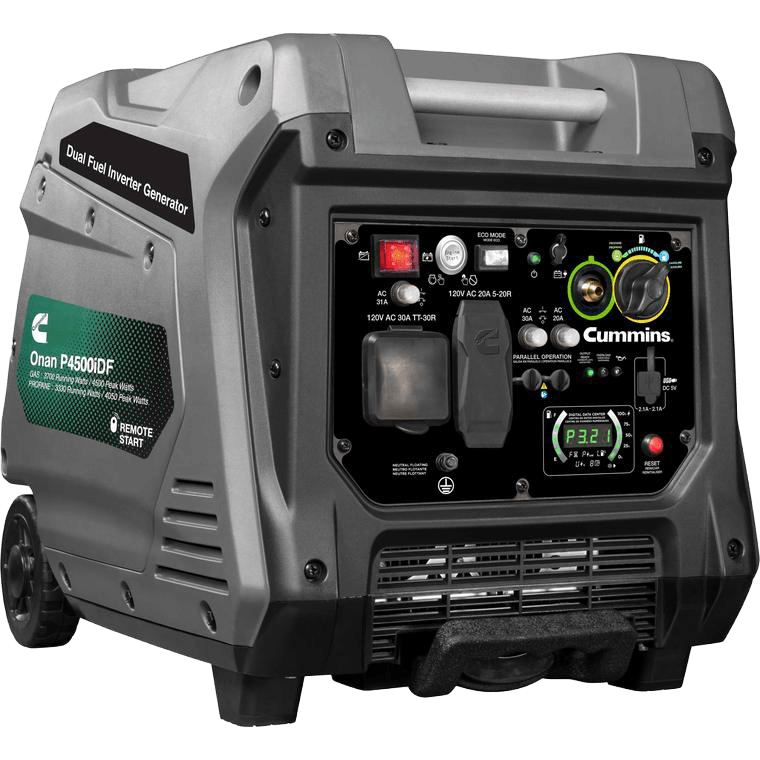
Dual-Fuel Inverter4,500 W peak
The P4500i with a fuel selector switch. Gasoline when you want the watts, propane when you want the shelf life — a 20-lb grill tank runs it 22 hours at 25% load.
Gas 4,500 / LP 4,050 W104.7 lb52 dB(A)22 hr on LP
| Output — gasoline | 4,500 peak W / 3,700 running W |
|---|---|
| Output — propane | 4,050 peak W / 3,330 running W |
| Peak amps | Gas 37.5 / propane 33.8 |
| Running amps | Gas 30.8 / propane 27.8 |
| Engine | 7.3 hp, 224 cc OHV four-stroke |
| Run time — gasoline | 3.4 gal — 18 hr at 25% load, 8.2 hr at 50% load |
| Run time — propane | 22 hr at 25% load on a standard 20-lb (4.6 gal) tank |
| Harmonic distortion | ≤3% THD |
| Outlets | One 120V 30A (TT-30R) · one duplex 120V 20A AC (5-20R) · two 5V USB |
| Paralleling | Ports for the Cummins 50-amp kit — pairs with a P4500i or P2500i |
| Starting | Push button and wireless key fob, pull-cord backup · battery charger |
| Dimensions | 25.5 × 18.1 × 20.5 in · telescoping handle, 5.5 in wheels |
| Dry weight | 104.7 lb (47.6 kg) |
| Sound level | 52 dB(A) |
| Warranty | 3-year residential / 1-year commercial |
120V, single phase · Certified compliant EPA / CARB / Canadian CSA · fuel selector switch enables changeover between gasoline and propane · economy mode switch.
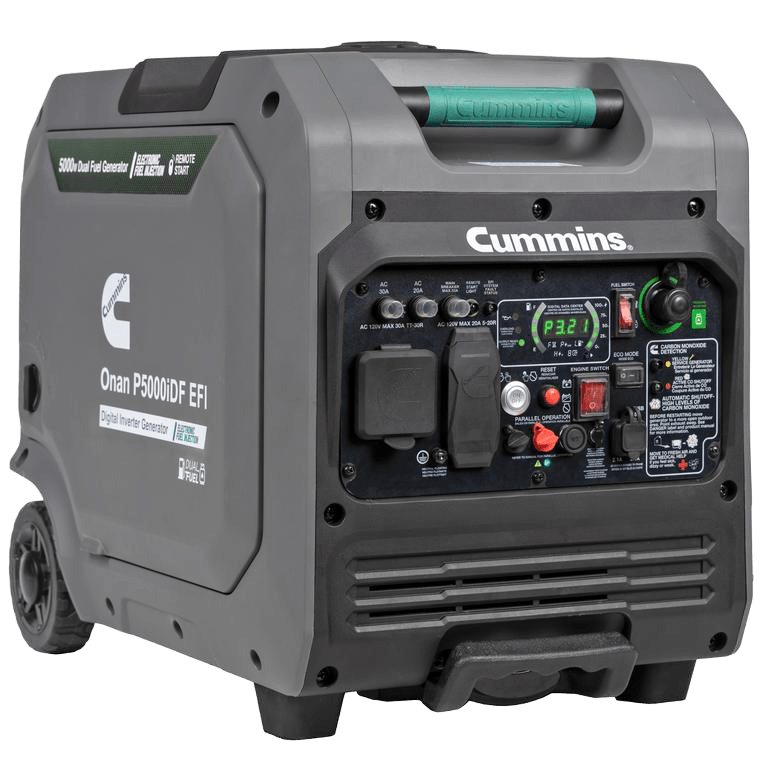
Dual-Fuel Inverter · EFI5,000 W peak
Electronic fuel injection instead of a carburetor: less fuel burned, longer run times, and full performance up to 13,123 feet without a high-altitude kit. No choke, no fuss.
Gas 5,000 / LP 4,500 W104.7 lb52 dB(A)EFI · No carb kit
| Output — gasoline | 5,000 peak W / 3,900 running W |
|---|---|
| Output — propane | 4,500 peak W / 3,500 running W |
| Peak amps | Gas 41.7 / propane 37.5 |
| Running amps | Gas 32.5 / propane 29.2 |
| Engine | 7.3 hp, 224 cc OHV four-stroke with electronic fuel injection |
| Altitude | Full performance to 13,123 ft (4,000 m) — no carburetor kit required |
| Emissions | Lower engine emissions and reduced fuel use vs. a carbureted engine |
| Outlets | One 120V 30A (TT-30R) · one 120V 20A (L5-20R) household · two 5V USB |
| Paralleling | Combines with another inverter generator using the optional paralleling kit |
| Display | Run hours, fuel level, voltage and remaining run time at a glance |
| Dimensions | 25.5 × 18.1 × 20.5 in · molded and telescoping handles, wheels |
| Dry weight | 104.7 lb (47.6 kg) |
| Sound level | 52 dB(A) |
| Warranty | 3-year residential / 1-year commercial |
120V, single phase · gasoline or propane selected with the flip of a switch · RV- and camper-ready 30A outlet · the practical upgrade over the P4500iDF for mountain use and long seasons.
03 — Dual-Fuel Open Frame · Home Backup Capable
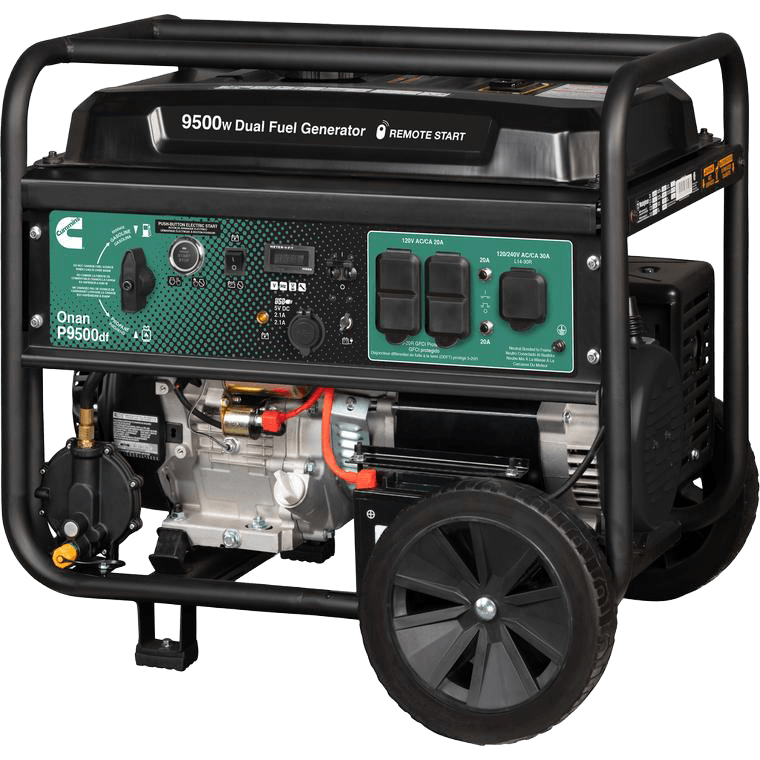
Dual-Fuel9,500 W peak
The one that gets a house through an outage. A 120/240V 30A twist-lock outlet feeds a transfer switch or an interlock, and remote start works from up to 109 yards away.
Gas 9,500 / LP 8,550 W194 lb74 dB(A)6.6 gal tank
| Output — gasoline | 9,500 peak W / 7,500 running W |
|---|---|
| Output — propane | 8,550 peak W / 6,750 running W |
| Peak amps (120/240V) | Gas 79 / 39 · propane 71.25 / 35.6 |
| Running amps (120/240V) | Gas 62.5 / 31 · propane 56 / 28 |
| Engine | 13 hp, 420 cc OHV four-stroke |
| Run time — gasoline | 6.6 gal — 16 hr at 25% load, 11 hr at 50% load |
| Run time — propane | 8 hr at 25% load on a standard 20-lb tank |
| Outlets | One 120/240V 30A twist-lock (L14-30R) · two duplex 120V 20A GFCI (5-20R) · two 5V USB |
| Starting | Push button and 109-yard remote start, pull-cord backup · battery charger included |
| Display | Data center — volts, frequency, run time, maintenance reminders, lifetime hours |
| Dimensions | 27.25 × 26.25 × 26.25 in · heavy-duty frame, foam-grip handle, 10 in wheels |
| Dry weight | 194 lb (88 kg) |
| Sound level | 74 dB(A) |
| Warranty | 3-year residential / 1-year commercial |
120/240V, single phase · fuel selector switch enables changeover between gasoline and propane · open-frame design — this is a work generator, not a campsite one. Ask GPM about a manual transfer switch or interlock kit for safe home connection.
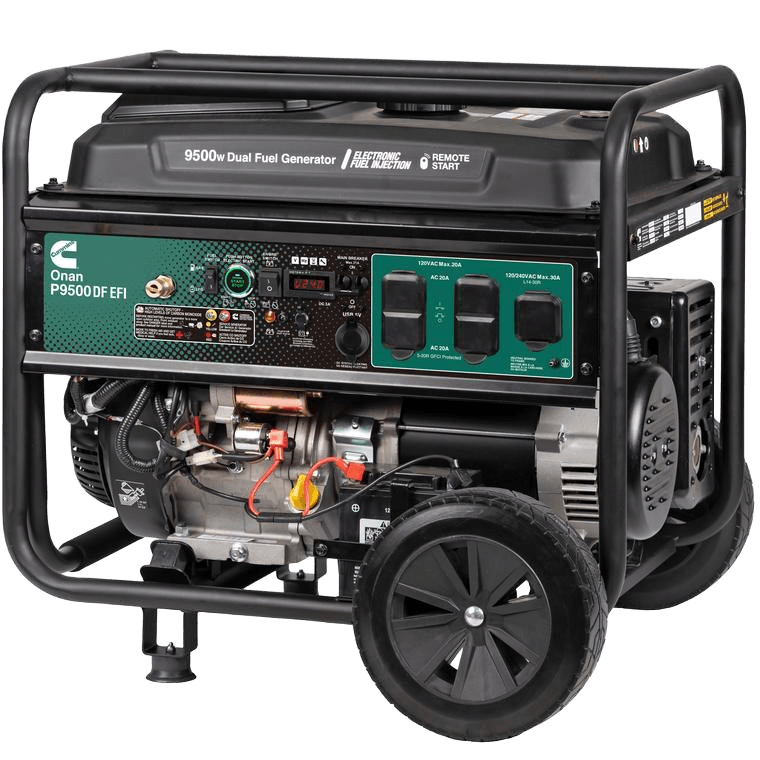
Dual-Fuel · EFI9,500 W peak
Same output, better manners. Fuel injection for longer run times and easier starts, an evaporative filter for lower emissions, and a carbon monoxide detector with automatic shutoff.
Gas 9,500 / LP 8,550 WCO shutoff74 dB(A)EFI · No carb kit
| Output — gasoline | 9,500 peak W / 7,500 running W |
|---|---|
| Output — propane | 8,550 peak W / 6,750 running W |
| Peak amps (120/240V) | Gas 79 / 40 · propane 71 / 36 |
| Running amps (120/240V) | Gas 62 / 31 · propane 56 / 28 |
| Engine | 13 hp, 420 cc OHV four-stroke with electronic fuel injection |
| Altitude | Full performance to 13,123 ft (4,000 m) — no carburetor kit required |
| Safety | Carbon monoxide detector with automatic shutoff · evaporative filter |
| Fuel capacity | 6.6 gal gasoline, or propane at the flip of a switch |
| Outlets | One 120/240V 30A twist-lock (L14-30R) · two duplex 120V 20A (5-20R) · two 5V USB |
| Starting | Push button and remote start · battery charging port with charger included |
| Display | Data center — volts, frequency and lifetime hours |
| Dimensions | 27.25 × 26.25 × 26.25 in |
| Dry weight | 194 lb (88 kg) |
| Sound level | 74 dB(A) |
| Warranty | 3-year residential / 1-year commercial |
120/240V, single phase · lower fuel use and longer run times versus a traditional carbureted engine · the model to pick if the generator will sit for months between storms.
04 — Tri-Fuel Inverter · The Big One
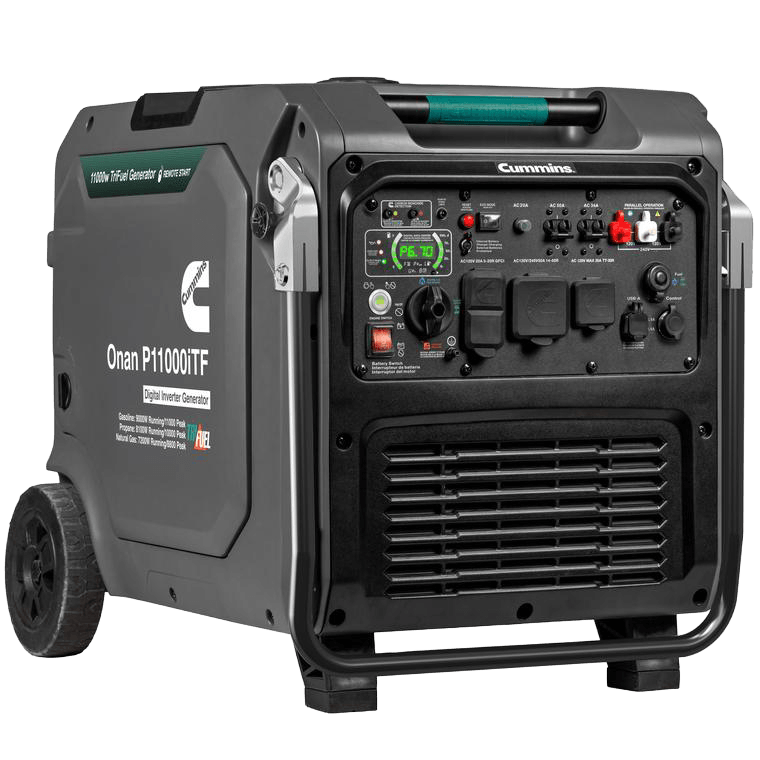
Tri-Fuel Inverter11,000 W peak
Gasoline, propane or natural gas at the turn of a dial — and enough output for two 15,000 BTU RV air conditioners, or a 2-ton HVAC system plus the rest of the essentials. Inverter-clean power at 64 dB(A), with CO detection and automatic shutoff standard.
Gas 11,000 W peakLP 10,000 W peakNG 8,800 W peak225 lb64 dB(A)50A outlet
| Output — gasoline | 11,000 peak W / 9,000 running W |
|---|---|
| Output — propane | 10,000 peak W / 8,100 running W |
| Output — natural gas | 8,800 peak W / 7,200 running W |
| Fuel selection | Switch between all three fuels at the turn of a dial |
| Typical loads | Two 15k BTU RV air conditioners, or a 2-ton HVAC system plus home essentials |
| Safety | Carbon monoxide detection with automatic shutoff |
| Outlets | 120/240V 50A (14-50R) · 120/240V 30A twist-lock (L14-30R) · 120V 20A GFCI duplex (5-20R) · two 5V USB |
| Starting | Push-button electric start with remote starter included |
| Display | Onboard LED — remaining run time, power output, fuel level, voltage, lifetime hours |
| Dimensions | 30.3 × 25.0 × 27.0 in |
| Dry weight | 225 lb |
| Sound level | 64 dB(A) |
| Warranty | 3-year residential / 1-year commercial |
120/240V · inverter output · the natural gas connection is what makes this one different from every other portable on the page — at home it never needs refueling. Ask GPM about the gas connection and transfer equipment.
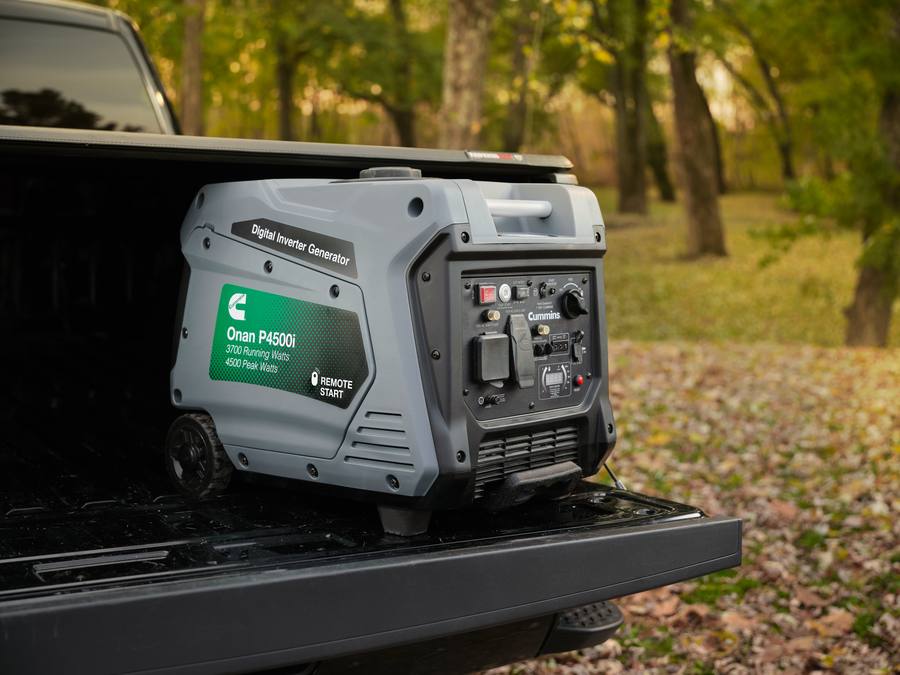
Tell us the three or four things that absolutely have to run — the fridge, the sump pump, the CPAP, the card reader — and we’ll add up the starting and running watts and name a model. No charge, no pressure.
Free sizingStocked in IL & FL
Identify what you need to power, total the wattage, and pick a model that covers about 90% of it. Cummins publishes this chart for a reason — watts on the box aren’t the same as watts you can use.
| Device | P2500i | P4500i | P4500iDF · P5000iDF | P9500DF | P11000iTF |
|---|---|---|---|---|---|
| Smartphone | |||||
| Blender | |||||
| Printer | |||||
| Coffee maker | |||||
| Light bulb | |||||
| Tire warmers | |||||
| Fan | |||||
| Laptop computer | |||||
| LED TV | |||||
| Refrigerator | — | ||||
| Microwave | — | ||||
| Hair dryer | — | ||||
| Circular saw | — | ||||
| Reciprocating saw | — | ||||
| Router | — | ||||
| Wet/dry vac | — | ||||
| Belt sander | — | ||||
| Air conditioner | — | ||||
| Air compressor | — | — | — | ||
| Leaf blower | — | — | — | ||
| Washing machine | — | — | — | ||
| Power washer | — | — | — | ||
| Sump pump | — | — | — | ||
| Partial home backup | — | — | — | ||
| Ideal uses | Small appliances Electronics Tailgating Camping |
Medium appliances RV use Camping Motorsports |
Medium appliances RV use Camping Motorsports |
Large appliances Home emergency backup Food trucks General contractor work |
Whole-circuit backup Two RV A/C units 2-ton HVAC Events & jobsites |
Chart shows the types of devices each portable can power — not all of them at once. Add up the starting and running wattage of everything you want running together to find the best match. The P5000iDF EFI matches the P4500iDF’s coverage with more headroom; the P9500DF EFI matches the P9500DF. GPM will run the numbers with you.
Standby generators sit and wait. A portable works all year — which is exactly why so many households end up owning one first, and why the ones who own one rarely regret it come February.
The P9500DF and P11000iTF have a 120/240V twist-lock outlet for exactly this reason. What they don’t have is a safe way to connect on their own — that part is a manual transfer switch or a panel interlock, installed by an electrician. Extension cords through a window work; backfeeding a dryer outlet can kill a lineman.
Never run a portable in a garage, shed, basement or breezeway — even with the door open. Keep it well away from windows and vents, downwind of the house.
The EFI and tri-fuel models shut themselves down if carbon monoxide builds up nearby. It’s the single best reason to spend up a model.
Every Cummins Onan portable carries a 3-year limited residential warranty (1 year commercial) backed by the largest service and support network in North America. Buy it from GPM and the warranty work, the parts, and the person who answers the phone are all in the same place.
Add up the running watts of everything you want on at the same time, then add the highest single starting surge on top — motors like refrigerators, sump pumps and air conditioners draw two to three times their running watts for a moment when they kick on. Aim for a model that covers about 90% of your list. A weekend of phones, lights and a TV lands on the P2500i; a fridge, a few power tools and an RV air conditioner puts you at the P4500 family; a house through an outage means the P9500DF or P11000iTF. Send us your list and we’ll do the math.
Inverter models (the “i” in P2500i, P4500i, P5000iDF, P11000iTF) condition the power electronically, producing 3% or less total harmonic distortion — clean enough for laptops, card readers, medical devices and modern TVs. They also throttle the engine down when the load is light, which is why they run at 52 dB(A) instead of roaring. Open-frame models like the P9500DF cost less per watt and are perfectly happy with tools, pumps and appliances, but they run at a fixed speed and are louder at 74 dB(A). If sensitive electronics are on the list, go inverter.
For most owners, yes — mainly because of storage. Gasoline degrades in a few months and has to be stabilized or rotated; a propane tank sits in the garage for years and is ready whenever you are. Propane gives up about 10% of the peak output, so a P4500iDF makes 4,050 watts on LP instead of 4,500 — but you keep the gasoline option for the days you need every watt. The tri-fuel P11000iTF goes one further and adds a natural gas connection, which means no refueling at all at home.
About the level of a quiet conversation or a household refrigerator, measured at a normal distance. It’s the reason the inverter models are welcome at campgrounds that ban ordinary generators, and why a neighbour twenty feet away is unlikely to complain. The open-frame P9500DF at 74 dB(A) is a different animal — closer to a vacuum cleaner. Fine at the back of a lot or a jobsite, less fine on a small suburban patio.
Partially, and only through the right connection. The P9500DF and P11000iTF have a 120/240V twist-lock outlet sized for a manual transfer switch or a panel interlock kit — that’s what lets you feed selected circuits safely. Never plug a generator into a wall or dryer outlet to backfeed the panel: it can energize the utility line and injure or kill a lineman working to restore your power. GPM can quote the transfer equipment with the generator and point you to an electrician for the install.
Less than people expect, more than most people do. Change the oil after the break-in period and then on the interval in the manual, keep a spare plug and air filter, and either run it dry or stabilize the fuel before it sits. Start it for a few minutes every month or two — a generator that never runs is the one that won’t start when the lights go out. Bring it to GPM before storm season and we’ll do it all, including a load test that proves it actually makes power.
Stock moves with the season — availability is highest before hurricane and winter storm seasons and thinnest right after one. Call or send the form and we’ll tell you what’s on the floor today, what’s inbound, and whether a comparable model would get you covered sooner. We’d rather put the right unit in your hands next week than the wrong one this afternoon.
Send the list — the fridge, the sump pump, the RV air conditioner, the card reader — and we’ll come back with a model, a price, and what’s actually on the floor.
Prefer to talk? Call (630) 532-6186